
Our recent marine metre squared survey
by Zel Ng, Greening of Kaipātiki Coordinator
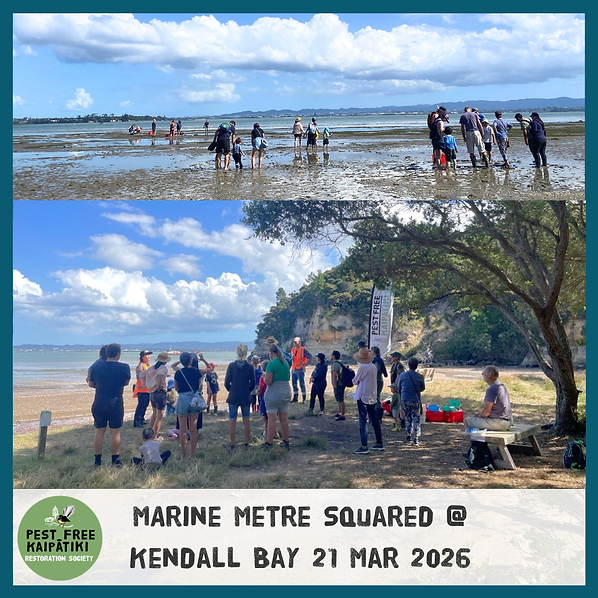
In March, a group of over 30 citizen scientists of all ages headed to the beach at low tide to conduct a marine metre squared survey, which involves recording the animals and plants living within 1m x 1m quadrats scattered across the shore. We braved the sun, wind and mud to scrutinise the shore and discover some of the wonderful creatures that live in the intertidal zone (the shore between high tide and low tide) in Kendall Bay.
One group far out on the low shore found lots of snapping shrimps around them, while another group, closer to the rocky shore, spotted an adorable cushion star. One lucky participant discovered a carpet shark egg case, while the sharp eyes of one of our youngest participants spotted the bright yellow underside of a speckled whelk.

The marine metre squared survey is a citizen science project established in 2013 by the New Zealand Marine Studies Centre at the University of Otago, with a mission for New Zealand to have the best understood coastlines in the world. It encourages communities to get involved in monitoring to better understand their local marine environment and help protect the many species that call it home.
Our citizen scientists, led by volunteer guides, laid down a 1m x 1m square, took note of surface marks present within that square (clues that tell us what lies beneath the surface), then counted all living creatures on the surface and in four core samples (extracting a 10cm deep core of sediment).

What we find on the shore can often tell us a story — for example, the presence of seagrass (also known as eelgrass), wedge clams and cockles in the bay are a positive indicator of marine health, as these species are sensitive to sediment build-up and pollutants.
Seagrass meadows are a crucial habitat and biodiversity hotspot. They also help filter the water and are a significant carbon sink. Many harbours across the country suffered extensive seagrass loss in the 1960s and 70s, so a return of seagrass populations is good news indeed. Monitoring cockle sizes over time is another way to assess the health of our shores, which is why our volunteers also measured the sizes of any live cockles found within their metre square — giving us crucial baseline data for future comparisons.
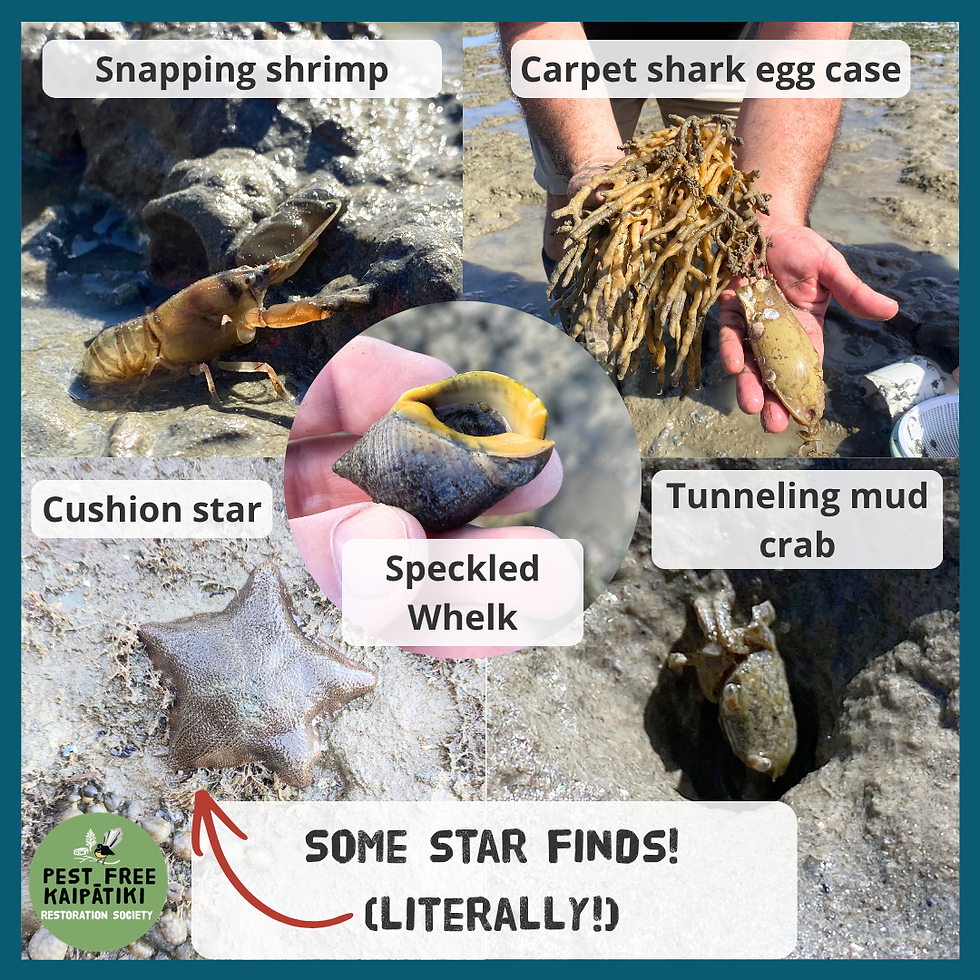
While at first glance the shore might look flat and empty, taking a moment to stand still and look around will reveal, especially on the low shore, a flurry of activity: crabs darting in and out of their burrows and an army of little mud whelks making their way across the mudflat. Digging into the sediment during a core sample unearths a healthy population of ribbon worms, bamboo worms and other burrowing bivalves hidden beneath the surface.
A huge thank you to all who joined us at the shore, to our hardworking volunteer guides and Kauri Point Centennial Park (KPCP) volunteers for facilitating the session, and to Chelsea Estate Heritage Park (CHERPA) and Chelsea School for their support. Thank you also to Auckland Council for supporting our work.

We share our shores and reserves with so many wonderful creatures. Get involved and volunteer with us to learn more about our natural environment and how to protect it!



Comments