
Kauri Connections: Kim O.

Kia ora tātou,
Welcome to the first Kauri Connections blog post! Our Kauri Connections blog series explores the kauri connections of us and other kauri friends. Keep on reading to find out about our long time volunteer and GIS genius Kim's connection to kauri trees.
Witnessing change in Kaipātiki's landscape over the years, kauri have been a part of Kim's everyday life from home to work, and a new creative project.
Q: When you think about kauri trees, what are three words that come up?
Tall, king of the forest, gum.
Like many of the older generation, when thinking about kauri, Kim thinks about kauri gum.
Kauri gum (kāpia) is highly valuable and in the past Māori used it to light fires, as chewing gum, and for tāmoko ink.

In the 19th century, kauri gum was exported to make a range of products, particularly varnish. Kauri gum became Auckland's main export until cheaper products came to the market.
Like kauri gum, the strong, straight and decay resistant qualities of kauri timber meant that it also became a major export. Kauri timber was sent to Britain, Australia and California until the 1950s.
Compared to other trees, the rangitira rākau status of kauri for Māori meant that kauri were not commonly used as timber, and special protocols were undertaken before a tree was used.
At home, Kim has "lots of old Kauri furniture. But that is all stopped now." He appreciates the strength and warm tone of kauri wood, but also reflects on how much the view of kauri has changed between now and the past: "People used to measure kauri trees by how many houses they could build." As kauri trees became more scarce, people began to notice, and the industry slowed and shifted to other native trees or exotic timber. In 1952 the Waipoua forest, home of Tāne Mahuta the largest living kauri tree, became protected; but this wasn't before Aotearoa saw the loss of 99% of kauri forests.
The great loss of kauri due to commercial logging has unfortunately increased the threat of PA (Phytopthora agathidicida) on existing kauri populations. PA, a microscopic watermold that lives in the soil, infects kauri trees through their roots and prevents them from accessing water and nutrients, which eventually leads to the death of the tree.
Kim's favorite kauri reserve in Kaipātiki is Kauri Park, where he used to walk daily.
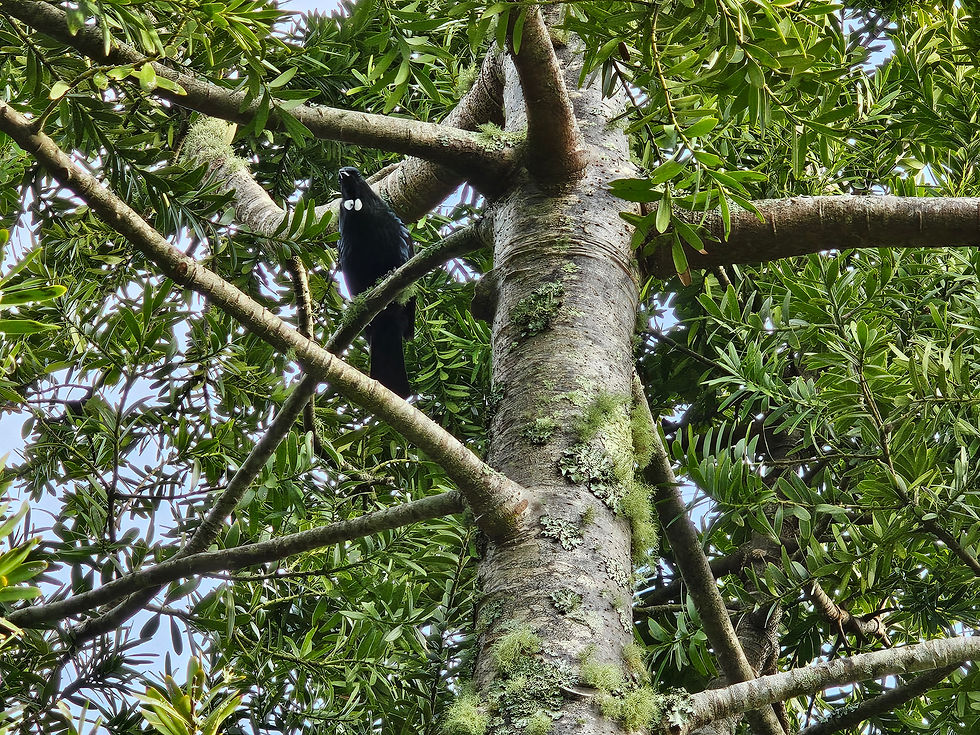
Kauri Park has now been closed due to a positive detection of PA. Though he cannot walk through the park as he used to, Kim can still see the kauri along the ridgeline from his house. He also has a kauri in his backyard. Watching the kauri, Kim has observed that native birds prefer perching in kauri, like the tūī he spotted in his garden below.
While walking through Chatswood reserve, Kim shares how all of the tracks are new. The cleaning stations and raised tracks protect the kauri from the spread of soil and PA. He also reflects on his past role, surveying tracks and pathways around Kaipātiki, making sure they were fit for use and up to date on the mapping system. His role brought him to the kauri groves of Kauri Glen, Chatswood, and Muriel Fisher to name a few.
Like many of us, Kim hopes that we find a practical cure for PA infection. Fortunately, phosphite treatment can reduce the effects of PA infection in kauri, returning most sick trees back to health. This is a great tool to have alongside other protection measures like soil hygiene (shoe cleaning) and track upgrades.
Right now, Kim is working on a storymap about Kaipātiki and PFK, this storymap highlights the mature kauri of Kaipātiki.
We have over 1000 mature Kauri trees in Kaipātiki, an amazing number for inner city reserves only 8 km from the Skytower.
Kaipātiki, is a suburban area with many kauri throughout: "They are everywhere in the local reserves. This is very unusual." Other than the kauri in the Waitākere or Hunua Ranges, the density of kauri in Kaipātiki is special for Tāmaki Makaurau.
Kim's storyboard also covers other aspects of Kaipātiki's environment and history. It features the predator control work that PFK volunteers do in reserves, and the results of catches across Kaipātiki's ecological Halos. In order to protect our local kauri, traps are placed away from kauri and additional cleaning procedures are needed for off-track work. Kim helps PFK develop kauri protection procedures by creating overlayed maps of traplines, kauri trees and cleaning stations.
Kim's GIS work is invaluable for PFK's work in reserves, and helps us make sure we are doing everything we can to protect our local kauri.
Keep an eye out on the PFK site, social media or newsletter for future Kauri connections blog posts. Click here to find out more about kauri protection.


Comments